

As a new player in World of Warcraft raids, you must understand your role, equip the best gear, and communicate effectively. Choose a class that fits your preferred playstyle—tank, healer, or DPS—knowing each has unique duties. Tanks manage enemy attention, healers maintain group health, and DPS maximize damage. Confirm your gear is of high item level, properly enchanted, and repaired. Participate in voice chats to stay aligned with your team’s strategy, and use consumables like potions and flasks wisely. Familiarize yourself with boss mechanics and teamwork tactics such as taunt swapping and cooldown rotations. With these foundations in place, you’re set for deeper exploration into complex raid challenges.
Key Takeaways
- Understand your class role—tank, healer, or DPS—and its responsibilities in the raid team.
- Equip the best gear, enhance it with enchantments and gems, and bring necessary consumables.
- Learn raid strategies, including positioning, boss mechanics, and team coordination.
- Communicate effectively through voice or text to ensure smooth collaboration and strategy execution.
- Set up a fair loot distribution system and discuss it with your team before starting the raid.
Understanding Raid Basics
Before you jump into your first raid in World of Warcraft, it’s crucial to grasp the fundamentals. Understanding raid group dynamics and preparing adequately can make or break your raiding experience. Here’s a straightforward raid preparation checklist to get you started.
Firstly, familiarize yourself with the raid’s objectives. Each raid has unique bosses, mechanics, and strategies. You’ll need to know the roles and responsibilities specific to the raid to contribute effectively.
Next, gear up appropriately. Confirm your character is equipped with the best possible armor and weapons you can obtain. This isn’t just about having high stats, but also about having the right type of gear to maximize your role’s effectiveness.
Communication is key in raid group dynamics. Join the raid’s voice chat, even if you’re shy. Listening in can provide crucial cues during the battle. Understand common terms like “tank,” “DPS,” and “heal,” as these roles determine the structure of your group.
Bring necessary consumables. Potions, food, and other items can boost your performance. Don’t rely on others to supply these; being self-sufficient is part of being a good team member.
Lastly, study the raid leaders and other experienced members during the raid. Observing their tactics and execution can offer practical insights not found in guides.
Choosing Your Class and Role

Choosing the right class and role for your raiding adventures in World of Warcraft is vital, as each class offers unique abilities that can profoundly impact your team’s success.
You’ll find that understanding class synergy and role flexibility can make or break your raid experience.
When you’re selecting your class, think about what gameplay style excites you the most. Do you prefer to be at the frontline, absorbing damage? Then perhaps a tank role is for you, with classes like Warriors or Paladins. If you’re more interested in healing your allies, a Priest, Druid, or Shaman could be your go-to. For those who love dealing damage, options abound, whether you’re into casting spells as a Mage or Warlock, or engaging in close combat as a Rogue or Hunter.
Class synergy refers to how well your class and its abilities complement the others in your raid group. Some classes provide buffs or debuffs that can greatly enhance group performance. For instance, a Monk’s ability to increase physical damage taken by the enemy is a boon for classes that deal primarily physical damage.
Role flexibility is another vital factor. Some classes, like Druids and Paladins, can switch between roles (tank, healer, damage dealer) depending on the needs of the team. This flexibility can be invaluable, especially in situations where your raid group might be lacking in a particular area.
Choosing wisely isn’t just about your personal enjoyment; it’s about how well you mesh with your team to conquer challenges together.
Take your time, explore each class’s strengths and weaknesses, and consider how your choice will fit into the larger raiding strategy.
Essential Raid Terminology
As you step into the world of WoW raids, you’ll need to get familiar with some essential terminology. Understanding raid roles, common strategies, and key mechanics can make or break your raiding experience.
Let’s start by breaking down the various roles you might take on, the strategies teams commonly employ, and the mechanics you’ll have to master to succeed.
Raid Roles Explained

Understanding the various raid roles is fundamental to your success in a World of Warcraft raid.
First off, you’ve got your tanks, whose responsibilities include absorbing damage and managing the attention of enemies. It’s essential they position themselves strategically to protect other members.
Next, healers play an important role by restoring health to the team. Their ability to manage buffs that enhance player abilities and debuffs that impair enemies can turn the tide of any battle. Healers must be aware of the group’s overall health and prioritize their healing targets accordingly.
Then there are the damage dealers, or DPS (damage per second), tasked with dealing as much damage to the enemies as possible. This group often includes varied classes that contribute through direct attacks or by using crowd control techniques to manage the battlefield.
Support functions can overlap with other roles, focusing on buff management and debuff strategies that weaken foes while strengthening allies. Effective support guarantees the team remains at peak fighting capability.
Lastly, mastering positioning tactics is key for all roles to avoid unnecessary damage and execute strategies smoothly.
Whether you’re absorbing hits, healing, dealing damage, or supporting, knowing where to be and when is a game changer.
Common Raid Strategies
Now that you’ve grasped the roles within a raid, let’s explore some common raid strategies and the terms you’ll need to know to navigate them effectively. Understanding raid positioning and boss strategies is essential to your success.
Here are some key terms and concepts you should familiarize yourself with:
- Stacking: This involves all players grouping tightly together. It’s often used to mitigate area-of-effect damage from a boss.
- Spreading: Opposite of stacking, you’ll spread out to avoid giving a debuff or area damage to other players.
- Kiting: A technique where you lead a boss or adds around the battlefield, typically used by ranged players to avoid taking damage.
- Taunt Swap: Used by tanks to manage the aggression or ‘aggro’ of the boss. Tanks alternate using their taunt abilities to guarantee they manage the damage effectively.
- Cooldown Rotation: Organizing the use of group-wide protective spells or abilities to survive intense boss attacks.
Each strategy requires careful coordination and precise execution.
You’ll often hear these terms shouted during a raid, so knowing them helps you react swiftly and correctly.
Stick with these basics, and you’ll enhance your raiding prowess greatly.
Key Raid Mechanics
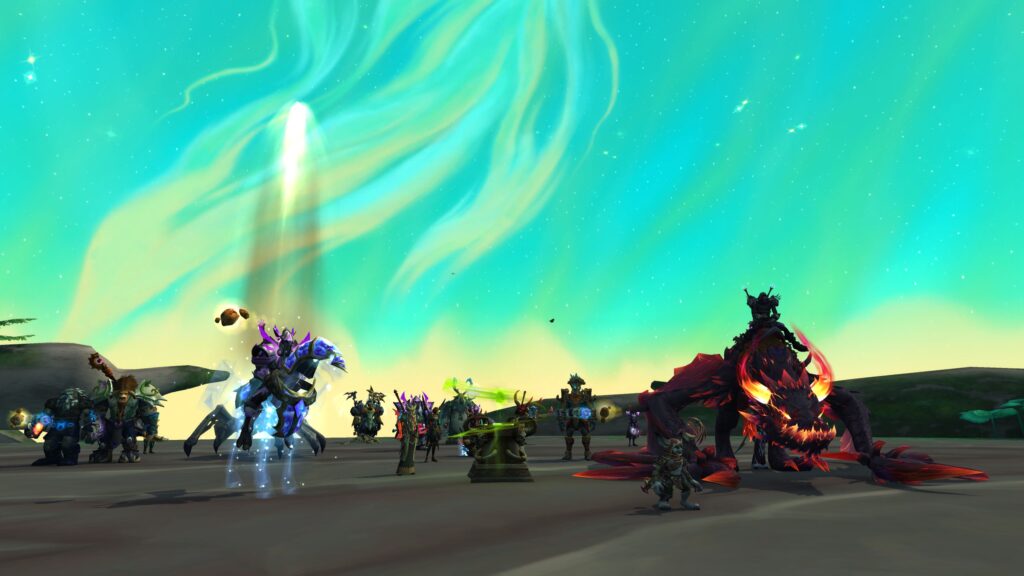
Mastering key raid mechanics is important for your success in WoW raids. To start, you’ll need to understand boss abilities, which are unique skills that bosses use to challenge your raid group. These abilities can range from powerful area attacks to debilitating debuffs on players. Recognizing and reacting to these abilities is essential.
Damage mitigation is another fundamental concept. This refers to the ability of tanks and other players to reduce the impact of incoming damage through various means such as shields, dodges, and specific class abilities. Effective damage mitigation guarantees the group’s sustainability and longevity during a fight.
You’ll also encounter terms like “aggro,” which refers to the attention a boss or enemy has towards a player, typically the tank. Managing aggro is crucial to controlling the flow of combat and keeping less durable members of your raid safe from direct hits.
Additionally, “cooldowns” are critical periods during which specific abilities can’t be reused immediately. Timing these cooldowns effectively can mean the difference between surviving a high-damage phase or facing a wipe.
Lastly, always stay alert for “environmental hazards” in the raid area. These can range from floor-based damage zones to interactive objects that can either aid or hinder your progress.
Preparing Your Gear
Before you immerse yourself in your first raid in World of Warcraft, it’s crucial to guarantee your gear is up to the task. The right preparation can mean the difference between a swift victory and a frustrating defeat.
Here’s what you need to focus on to verify you’re raid-ready:
Firstly, gear upgrades are essential. You’ll want to equip the highest item level gear available to you. This not only boosts your basic stats like strength, agility, and intellect but also your stamina, making you tougher to take down.
Don’t just wear any high-level gear, though; make sure it complements your character’s build and strengths.
Optimal enchantments can greatly enhance your gear. Enchanting your equipment provides valuable boosts to your abilities and stats. Research which enchantments are best suited for your class and role within the raid.
To streamline your preparation, consider these key points:
- Check item levels: Confirm all gear is of the highest available item level.
- Optimize enchantments: Apply the best enchantments for your specific class and role.
- Gem sockets: Insert powerful gems to further enhance your attributes.
- Repair: Always enter a raid with fully repaired gear.
- Consumables: Stock up on potions, flasks, and food that boost your stats.
Teamwork and Communication

Now that you’re geared up, it’s vital to focus on teamwork and communication in your WoW raids.
You’ll need to use essential communication tools efficiently, clarify each player’s role through strategic discussions, and coordinate actions to tackle challenges effectively.
Mastering these elements guarantees your team operates like a well-oiled machine, ready to face any boss that comes your way.
Essential Communication Tools
Why is clear communication essential in a WoW raid? It’s the backbone of any successful team effort, ensuring that everyone is on the same page during complex battles. When you’re coordinating with a group, the ability to share information quickly and clearly can make or break your raid success.
Here’s what you need to keep in mind:
- Voice Chat: Essential for real-time strategy discussions and immediate callouts.
- Text Communication: Useful for raid planning and when voice isn’t an option.
- Feedback Loops: Encourage giving and receiving constructive feedback to improve team performance.
- Signal Coordination: Critical for managing complex mechanics that require precise timing.
- Communication Etiquette: Respecting each other fosters a positive raid environment and enhances cooperation.
Voice chat is particularly crucial; hearing a teammate’s callouts can save the raid from a wipe.
Text communication keeps a record of plans and strategies that can be referred to later.
Always participate in feedback loops; they help identify what’s working and what isn’t.
Role Clarification Strategies
Understanding each player’s role is essential in a WoW raid, as it guarantees that everyone knows their responsibilities and how they contribute to the team’s objectives. Role assignment techniques are vital, and you’ll want to distribute roles based on each player’s strengths and prior experience. Remember, it’s not just about who does what; it’s about ensuring role synergy so that the group functions as a cohesive unit.
Here’s a brief guide to help you understand key roles and their interdependencies:
| Role | Main Responsibility | Synergy Tips |
|---|---|---|
| Tank | Absorbing damage, controlling mobs | Coordinate with healers for timely heals |
| Healer | Keeping the team alive | Stay aware of tanks and DPS positions |
| DPS | Dealing damage to enemies | Focus fire on priority targets agreed upon |
| Support | Buffing, debuffing, crowd control | Communicate with all to optimize spell timing |
Using these roles effectively requires good communication. You’ll need to stay in constant dialogue to adapt to dynamic raid scenarios. Discuss strategies beforehand and make sure everyone’s on the same page during the raid. This approach not only maximizes each role’s effectiveness but also enhances overall team performance. Remember, success in a raid is about how well you work together, not just individual skill.
Effective Team Coordination
While role clarification sets the stage for raid success, effective team coordination elevates your performance by ensuring smooth communication and teamwork.
Mastering team dynamics is vital; it helps you adapt to various situations within the raid. As you venture into larger raids, you’ll notice the importance of conflict resolution. Disagreements might arise, but it’s necessary to address them quickly and constructively to maintain group harmony.
To enhance your team coordination in WoW raids, consider these tactics:
- Regular Communication: Keep the lines open. Use voice chat for real-time strategy adjustments.
- Clear Call-outs: Assign one or two members to make important call-outs during the raid.
- Pre-raid Briefings: Discuss strategies and potential conflict points before starting.
- Post-raid Debriefs: Reflect on what went well and what could be improved for future raids.
- Respectful Feedback: Offer constructive criticism and be open to receiving it as well.
Learning Boss Mechanics
How do you conquer the complexities of boss mechanics in WoW raids? First, you’ll need to familiarize yourself with both boss abilities and encounter strategies. Each boss in a raid has a unique set of abilities that can decimate your party if you’re not prepared. Consequently, understanding these abilities is essential.
Start by watching raid guides or reading strategy breakdowns. These resources usually offer detailed insights into what you can expect from each boss. Pay special attention to any specific triggers or cues that indicate a boss is about to use a critical ability. This could be anything from a visual glow to a specific sound.
Next, participate in discussions within your raid group. More experienced members can provide firsthand insights on dodging lethal attacks or exploiting a boss’s vulnerabilities. It’s all about teamwork, and sharing knowledge is key to collective success.
Practice makes perfect. Utilize raid simulators or training dummies to hone your responses to boss abilities. Simulation tools are particularly useful as they can mimic the raid environment and help you get a feel for the timing and scope of boss attacks.
During the actual raid, keep communication open. If someone notices a pattern or a potential strategy adjustment, it’s important they can relay that information quickly and clearly.
Always stay adaptable; sometimes the best-laid plans need adjustment on the fly based on how the encounter is progressing.
Managing Raid Consumables
Managing raid consumables effectively can greatly boost your group’s performance in a raid. It’s vital to understand the different consumable types and their strategic uses. By mastering resource management, you’ll guarantee that your team is always ready with the necessary buffs and heals to tackle any challenge.
Firstly, know what consumables are essential for your class and role. Tanks, healers, and DPS (damage per second) classes will each have different needs. Here’s a quick rundown of important items:
- Flasks: These provide a long-lasting stat boost and are essential for all raid members.
- Potions: Used for quick health recovery or damage enhancement. Timing their use during critical fight phases can turn the tides in your favor.
- Food: Grants buffs that can enhance various stats depending on the meal prepared.
- Scrolls: Useful if your group lacks certain class-specific buffs.
- **Battle Elixirs and *Guardian Elixirs***: These can be used together or separately for either offensive or defensive boosts.
Next, coordinate with your raid to avoid wastage. Discuss who brings what and guarantee that there are enough supplies for everyone. Bulk crafting or purchasing ahead of time can save costs and last-minute scrambles.
Keep track of your inventory. Use addons or built-in game features to monitor your consumable levels during the raid. Replenish as necessary between attempts.
Finally, practice good resource management by only using consumables when beneficial. Misused items are wasted resources, so communicate with your team and plan usage strategically to maximize their effects.
This approach not only optimizes performance but also conserves valuable resources for when they’re truly needed.
Navigating Raid Environments
As you step into your first raid, it’s essential you understand the layout and anticipate environmental hazards that can throw you off.
Each raid is designed with unique challenges, from lava pits to collapsing floors, so keep your eyes open and always stay on the move.
Understanding Raid Layouts
Maneuvering raid environments in World of Warcraft requires a keen understanding of each layout’s unique challenges and mechanics.
Guiding through these complex spaces is essential for both survival and success. Let’s explore the different raid layout types and raid zone differences you’ll encounter.
- Linear Layouts: These have a straightforward path from start to finish. You’ll face bosses one by one, making it easier to predict what’s next.
- Non-linear Layouts: Here, you can choose your path to some extent. This flexibility allows for strategic planning but increases the risk of stumbling into unexpected challenges.
- Open World Areas: These zones mimic the open world and often feature multiple bosses and events in a less structured format.
- Instance-based Zones: These are contained environments with controlled entry points. Each section usually culminates in a boss fight, segmented away from the main world.
- Mixed Layouts: Combining elements of both linear and non-linear designs, these layouts offer a balanced challenge with a variety of paths and encounters.
Understanding these layouts helps you prepare for the tactical decisions you’ll need to make.
Whether it’s choosing which boss to tackle first in a non-linear layout or guiding through a complex instance-based zone, your strategy will greatly impact your raiding success.
Managing Environmental Hazards
After exploring the variety of raid layouts in World of Warcraft, it’s equally important to contemplate the environmental hazards that each setting presents. You’ll need to develop sharp environmental awareness to navigate these effectively. Hazard avoidance isn’t just about reacting; it’s about anticipating. Here’s how you can stay ahead:
Firstly, always keep an eye out for ground effects. These can range from fiery patches that damage over time to icy areas that reduce your movement speed. Knowing what each effect looks like and how it impacts your gameplay is vital.
Secondly, watch for mechanics that require movement. Some bosses might trigger attacks that cover large areas, necessitating a quick relocation. Positioning yourself in such a way that you can swiftly move out of harm’s way without compromising your role is key.
Lastly, communication with your team is essential. Calling out hazards can save your entire group from a fatal mistake. Here’s a quick reference to help you out:
| Hazard Type | Visual Cue | Response Strategy |
|---|---|---|
| Fire | Red, flaming patches | Move away immediately |
| Ice | Blue, frosty areas | Avoid to prevent slow |
| Poison | Green, bubbling pools | Steer clear, range attack |
Mastering these elements enhances your raid performance considerably. Stay alert, and you’ll find yourself contributing more effectively to your team’s success.
Handling Loot and Rewards
When you complete a raid in World of Warcraft, distributing the loot among your team is an important step. Managing this loot effectively guarantees that everyone feels rewarded for their effort and can greatly impact your team’s morale and performance in future raids.
Here’s how you can handle loot distribution and reward management effectively:
- **Know the *loot system***: Before starting the raid, agree on a loot distribution system. Whether it’s need before greed, a loot council, or a point system, clear rules prevent conflicts.
- Communicate clearly: During and after the raid, keep communication open regarding loot decisions. This transparency helps maintain trust among team members.
- Be fair: Distribute rewards based on contribution, attendance, and raid needs. Fairness in loot distribution is vital for keeping the team motivated.
- **Use *add-ons***: Consider using loot distribution add-ons to streamline the process. These tools can help manage and track who gets what, guaranteeing a smooth distribution.
- Record keeping: Keep records of who received what loot. This log can be useful for reviewing decisions and planning future distributions.
Handling loot effectively isn’t just about keeping track of who gets what; it’s about guaranteeing that everyone feels valued and fairly treated.
By setting clear guidelines and using the right tools, you can manage rewards in a way that supports both individual and team growth.
Dealing With Raid Challenges
While handling loot is essential, you’ll also face various challenges during raids that require quick thinking and adaptability. Each raid in WoW is a complex puzzle, where your ability to adjust on the fly can make or break your group’s success. Understanding raid adaptability strategies is significant, especially when tackling new bosses or mechanics.
Firstly, always be prepared to switch tactics. Raids often throw unexpected scenarios at you, and sticking rigidly to a single strategy could lead to failure. If a boss suddenly changes its attack pattern or introduces new minions, you’ll need to adapt your role and responsibilities quickly. This might mean shifting from offense to defense, changing your target, or even altering your position.
Secondly, communication is your best tool for overcoming encounter obstacles. Always keep in touch with your team through voice or text chat. If you notice something off, such as a change in the boss’s behavior or a new environmental hazard, call it out immediately. Effective communication helps in coordinating group movements and strategy adjustments swiftly.
Lastly, learn from each attempt. Every failure is a chance to refine your approach. Discuss what went wrong and what could be done better next time. Pay attention to feedback and be open to trying different approaches that might work better suited to your team’s unique dynamics.
Frequently Asked Questions
How Often Do New Raids Get Released in Wow?
You’ll notice new raids typically launch with each expansion, about every two years. Raid release frequency can vary, but major updates often bring fresh content. Keep an eye on announcements for the latest schedules.
Can I Solo Old Raid Content Effectively?
Diving into the past, you can effectively solo old raid content with the right strategies. Mastering solo tactics guarantees you’ll bag the coveted raid loot, turning yesteryear’s challenges into today’s treasure hunts.
What Are the Penalties for Leaving a Raid Early?
If you leave a raid early, you’ll face social consequences and breach raid etiquette. You might be seen as unreliable, which can hinder your ability to join future groups or raids.
How Does Cross-Realm Raiding Work?
You can join raids across different domains using cross-realm mechanics, which expand your raid grouping options. This feature lets you team up with players not on your server, enhancing flexibility and raid availability.
Are There Any Age Restrictions for Participating in Wow Raids?
You’ll find no specific age requirements for WoW raids, making raid accessibility quite open. As long as you can handle the game’s content, you’re free to join in on the raiding fun.
Conclusion
Now that you’re equipped with the essentials of raiding, plunge in with confidence. Remember, choosing the right class and understanding your role are vital—like gears in a well-oiled machine, every player is essential. Keep your gear prepped, communicate effectively, and manage your consumables wisely. As you navigate complex raid environments and tackle challenges, cooperation is your greatest weapon. Embrace each raid as a learning opportunity, and enjoy the thrill of conquering epic bosses and reaping well-earned rewards.
Leave a Reply